

Quick Verdict: Best Ethical Investing Apps at a Glance
- Best Overall for Custom Screening & Holdings Transparency: Honestly Invest – Unlocks direct equity ownership, line-item negative screening (excluding individual stocks), and customized portfolio rules without high net worth minimums.
- Best for Hands-Off Passive ESG Bundles: Preset Robo-Advisors (e.g., Betterment / Wealthfront) – Ideal for generalist investors seeking automated, broad-market ESG ETF portfolios without customized rules.
- Best for Active DIY Traders: Self-Directed Brokerages (e.g., Fidelity / Interactive Brokers) – Best for experienced investors with time to manually research individual corporate balance sheets and handle portfolio rebalancing.
The Democratization of Custom Investing
For decades, true portfolio customization was a luxury strictly reserved for family offices, institutional endowments, and ultra-high-net-worth (UHNW) investors. If a client with $25 million in assets wanted to strip fossil fuel producers, private prisons, or weapons manufacturers out of their index benchmarks, private wealth managers used custom direct indexing to build a bespoke basket of individual equities tailored precisely to their values.
Everyday retail investors, however, were pushed into mass-market products – specifically off-the-shelf Environmental, Social, and Governance (ESG) exchange-traded funds (ETFs) and mutual funds. While marketed as “responsible,” these broad funds frequently left investors dismayed. Due to market-cap-weighted scoring methodologies and synthetic rating models, major broad ESG ETFs often contain fossil fuel conglomerates, big tech companies with supply chain controversies, or defense contractors. Retail investors were forced to accept an all-or-nothing compromise.
Today, rapid technological advancements have permanently disrupted this dynamic. Institutional-grade direct indexing and line-item equity screening have been democratized. Modern financial technology now allows investors at any budget to move past pre-packaged ESG funds and claim complete, line-item ownership over their portfolios. This guide benchmarks the best ethical investing platforms, comparing how Honestly Invest, preset ESG robo-advisors, and self-directed brokerages stack up on holdings transparency, custom screening depth, tax efficiency, and total cost of ownership.
What Makes a Truly Ethical Investing Platform?
Evaluating an ethical investing broker or app requires looking far beyond marketing claims and broad sustainability badges. When selecting a platform to manage your wealth, savvy investors evaluate five essential dimensions of transparency and control:
1. Full Transparency: Knowing Exactly What You Own
The core limitation of traditional ESG funds and mutual funds is the “black box” wrapper. When you purchase an ETF share, you own a fund unit, not the underlying stocks. This obscures visibility into daily corporate operations. A truly transparent ethical platform provides 100% line-item visibility into every individual equity holding in your account, ensuring you never passively fund corporate practices you oppose.
2. Granular Negative Screening (Line-Item Veto)
Effective values alignment requires the technical capability to apply negative screens at the line-item level. Rather than excluding entire economic sectors, investors should be able to exclude specific business activities, sub-sectors, or individual companies – such as thermal coal extractors, controversial weapons makers, or organizations with poor board diversity – without breaking overall portfolio risk balance.
3. Positive Values Alignment (Tilting)
Ethical investing is not solely about avoiding harm; it is equally about deploying capital toward positive solutions. Top platforms enable positive tilting – allowing users to overweight companies actively advancing clean energy transition, fair labor standards, organic agriculture, or affordable housing development.
4. Direct Indexing vs. ETF Bundling
Holding direct shares rather than pooled fund units grants investors direct shareholder rights, individual stock flexibility, and total portfolio transparency. Direct indexing empowers the underlying portfolio software to swap out non-compliant companies while purchasing similar industry peers to maintain broad market diversification.
5. Tax Efficiency & Automated Rebalancing
Executing strict negative screens across single stocks creates tracking variance against broad benchmarks. Advanced platforms continuously run automated rebalancing algorithms to maintain target asset class weights and perform individual stock-level tax-loss harvesting – offsetting capital gains while maintaining your ethical parameters.
Comprehensive Platform Comparison Matrix
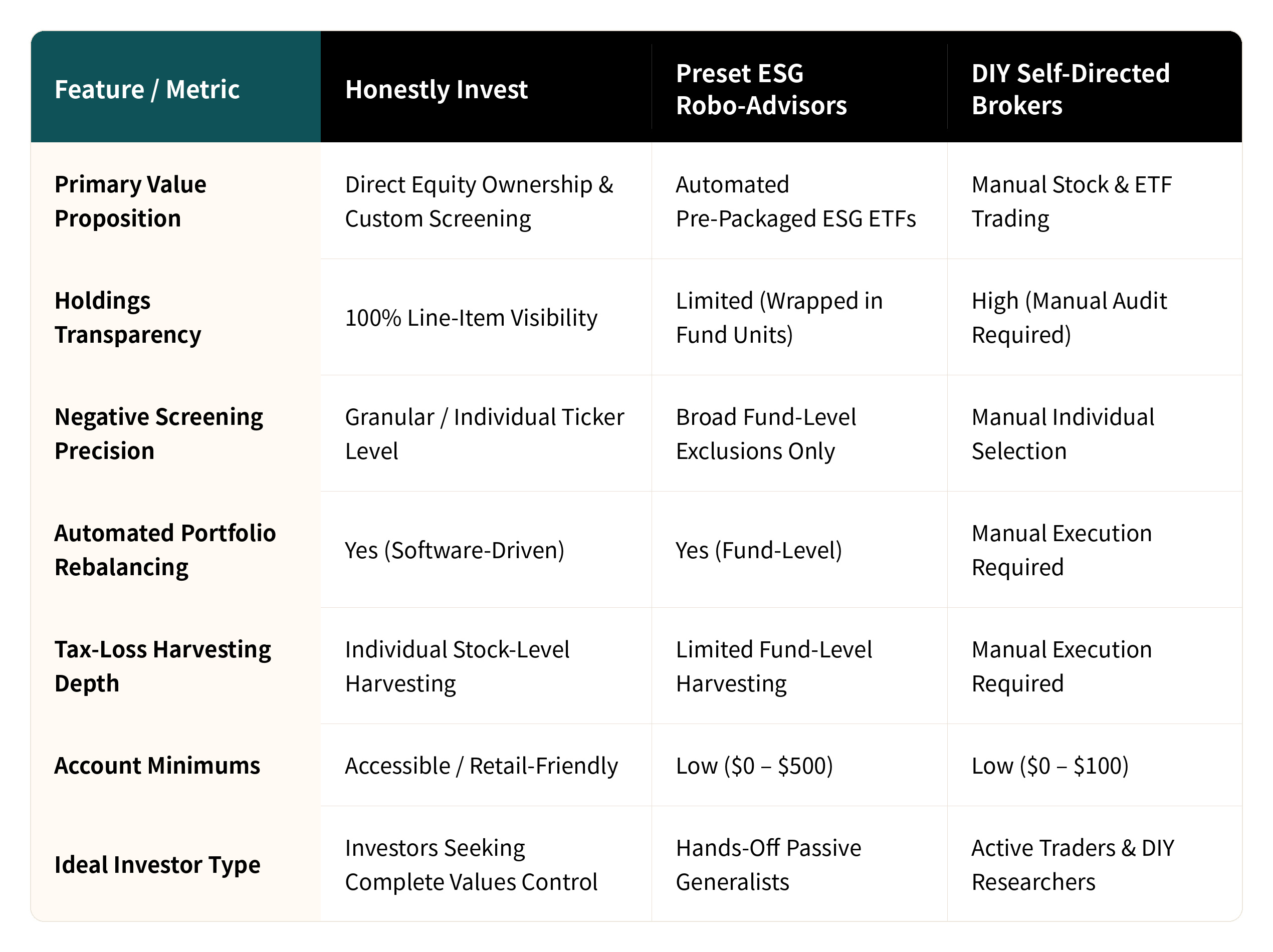
Platform Deep-Dive 1: Honestly Invest (The Customization Leader)
Honestly Invest was built specifically to solve the structural compromises of legacy ethical investing. By leveraging fractional share trading and direct-indexing software, Honestly Invest brings institutional-grade portfolio construction directly to everyday retail investors.
How Direct Stock Ownership Eliminates the “Black Box”
When you open an account with Honestly Invest, you do not buy pre-packaged ESG ETFs that hide conflicting holdings. Instead, the platform creates a customized direct portfolio of individual equities tailored to your target risk profile and asset allocation. Because you own the underlying shares directly, you gain total line-item transparency over every stock in your account.
Unmatched Line-Item Negative Screening
Honestly Invest replaces generic corporate ESG scores with direct user control. Investors can configure precise, non-negotiable screening rules across Environmental, Social, and Governance categories. Whether your goal is to eliminate fossil fuel reserves, defense contractors, private prison operators, or companies with documented labor violations, the platform’s screening engine removes non-compliant tickers from your universe instantly.
Automated Risk Management & Smart Rebalancing
Removing stocks from a standard market index introduces sector drift if not managed correctly. Honestly Invest’s portfolio engine automatically reallocates capital into compliant sector peers, preserving target asset class ratios, market-cap exposure, and risk-adjusted return profiles. As market prices fluctuate, automated algorithms continuously rebalance your holdings without triggering unnecessary tax drag.
The Honestly Invest Advantage
Institutional direct indexing used to require $1,000,000+ in account minimums and expensive wealth management fees. Honestly Invest provides total line-item stock visibility, automated screening, and tax optimization in an accessible, user-friendly platform.
Platform Deep-Dive 2: Preset ESG Robo-Advisors
Automated robo-advisors (such as Betterment, Wealthfront, or Acorns) popularized passive wealth management by offering pre-built “Socially Responsible Investing” (SRI) portfolio options. These portfolios substitute standard index funds with broad ESG-themed ETFs (e.g., Vanguard ESGV or iShares ESGU).
The Structural Limitations of Off-the-Shelf ESG Funds
While preset robo-advisors offer effortless setup and low account minimums, they suffer from significant structural limitations for values-conscious investors:
- No Custom Screening Veto: You cannot exclude an individual stock from a third-party ETF. If an ESG ETF holds a tech company or energy firm you oppose, you must accept the entire fund bundle.
- ESG Rating Divergence: Third-party ESG ratings measure financial materiality risk rather than moral impact. Consequently, high ESG scores are frequently assigned to massive fossil fuel producers or military contractors simply because they maintain strong internal compliance policies.
- Layered Expense Ratios: Investors pay both the robo-advisor’s account management fee (typically 0.25%–0.35% AUM) and the underlying ETF expense ratios (0.10%–0.20%), creating compounded fee drag over time.
Platform Deep-Dive 3: DIY Self-Directed Brokerages
Experienced stock pickers often attempt to build values-aligned portfolios using self-directed brokerages like Fidelity, Charles Schwab, or Interactive Brokers. By manually purchasing individual stocks, investors can avoid third-party ESG funds altogether.
The Hidden Friction of DIY Ethical Investing
While self-directed trading offers maximum flexibility, maintaining a diversified ethical portfolio manually creates severe operational friction:
- Excessive Research Drag: Uncovering corporate supply chain practices, carbon footprints, and governance controversies requires reading hundreds of pages of corporate sustainability reports and SEC disclosures.
- Rebalancing Complexity: As stock prices fluctuate, keeping a 50-stock portfolio properly weighted requires constant fractional share calculations, manual order execution, and continuous monitoring.
- Tax Inefficiency: Individual traders rarely have access to algorithmic tax-loss harvesting software capable of scanning single-stock lots daily to capture tax losses while maintaining sector balance.
How to Choose the Right Ethical Investing Platform
Selecting the best ethical investing platform depends on your desire for holdings control, available research time, and performance priorities. Use this 4-step framework to guide your decision:
- Demand Line-Item Visibility: Decide whether you want full visibility into every single stock in your account or if you are comfortable holding opaque ETF fund bundles.
- Identify Your Non-Negotiables: Determine if you have strict, absolute dealbreakers (e.g., zero fossil fuel revenue, no weapons manufacturing). If so, opt for direct line-item screening platforms like Honestly Invest.
- Assess Total Cost of Ownership: Calculate total annual costs by factoring in platform subscription fees, AUM management charges, and fund expense ratios.
- Verify Security & Regulatory Protections: Ensure your platform uses bank-level encryption, carries SIPC insurance protection (up to $500,000 for securities), and works with established custodial banks.
Take Full Control of Your Investments Today
You no longer need to settle for black-box ESG funds or spend hours managing manual stock spreadsheets. Experience institutional-grade direct indexing and line-item transparency tailored to your exact principles.
Get started free with Honestly Invest today
Frequently Asked Questions (FAQ)
Q1: How do modern platforms make custom investing accessible to retail investors?
Financial technology advancements—including fractional share execution, automated rebalancing algorithms, and low-cost API integrations—have dramatically reduced execution costs. This allows software platforms like Honestly Invest to offer custom direct indexing and stock-level screening without the multi-million-dollar account minimums traditionally required by private wealth managers.
Q2: What is the difference between generic ESG ratings and line-item portfolio screening?
Generic ESG ratings aggregate complex, arbitrary corporate risk scores into a single numeric grade, often hiding controversial business activities inside broad ETF wrappers. Line-item portfolio screening gives you direct visibility into every individual equity in your portfolio, empowering you to exclude specific companies or sub-sectors based on your exact values.
Q3: Does custom negative screening lower overall investment returns?
Not necessarily. Modern direct indexing technology allows algorithms to exclude non-compliant stocks and immediately substitute them with compliant, highly correlated industry peers. This maintains target sector weights and broad market risk-adjusted return parameters while adhering strictly to your moral boundaries.
Q4: Are my assets safe on modern ethical investing platforms?
Yes. Reputable financial technology platforms partner with regulated custodial brokerages. Uninvested cash and securities are protected by SIPC insurance up to $500,000 (including up to $250,000 for cash claims) against custodial failure, and accounts utilize industry-standard 256-bit encryption.
Important Disclosure: Any information on this website or in this article is provided for informational and educational purposes only and is not intended as, and should not be construed as, investment, tax, accounting, or legal advice.
Information provided should not be solely relied upon for decision making. Please consult your financial adviser and/or your legal, tax, or accounting professional regarding your specific situation. Investments involve risk and have the potential for complete loss. It should not be assumed that any recommendations made will necessarily be profitable. The information on this website and in this article is provided “AS IS” and without warranties either express or implied and the information may not be free from error. Your use of any information on this website or in this article is at your sole risk.