

A step-by-step framework for values-based portfolio construction.
Investing with Purpose
For a new generation of investors, ethical investing is no longer a niche concept. “How much can I make?” is still front of mind, but a second question now runs right alongside it: “How is my money making a difference — or is it doing harm?”
New to the idea? Our Ethical Investing for Beginners guide covers what ethical investing means, why it matters, and the key terms (SRI, ESG, impact investing) — start there if you need the fundamentals first. This guide picks up from there and focuses entirely on execution: turning your values into an actual, diversified portfolio.
How to invest ethically isn’t about sacrificing performance. It’s about making sure your capital doesn’t silently fund industries or practices you oppose — and the mechanics matter as much as the motivation. Here’s exactly how to translate that principle into a real portfolio, step by step:
- Defining your non-negotiables
- Translating principles into concrete criteria
- Screening assets effectively
- Building a diversified portfolio
- Maintaining alignment over time
A 5-Step Framework for Values-Based Investing
Step 1: Identify Your Core Values
Before looking at a single stock chart or fund prospectus, establish your personal baseline. Without clarity on what you stand for, your screening process will quickly become inconsistent.
The “values card sort” exercise:
- Write down every corporate issue or global cause you care about.
- Sort them into three piles: non-negotiables, important, and unsure/neutral.
- Force yourself to narrow your non-negotiables down to 3–5 core priorities.
Most people’s priorities fall into four broad categories:
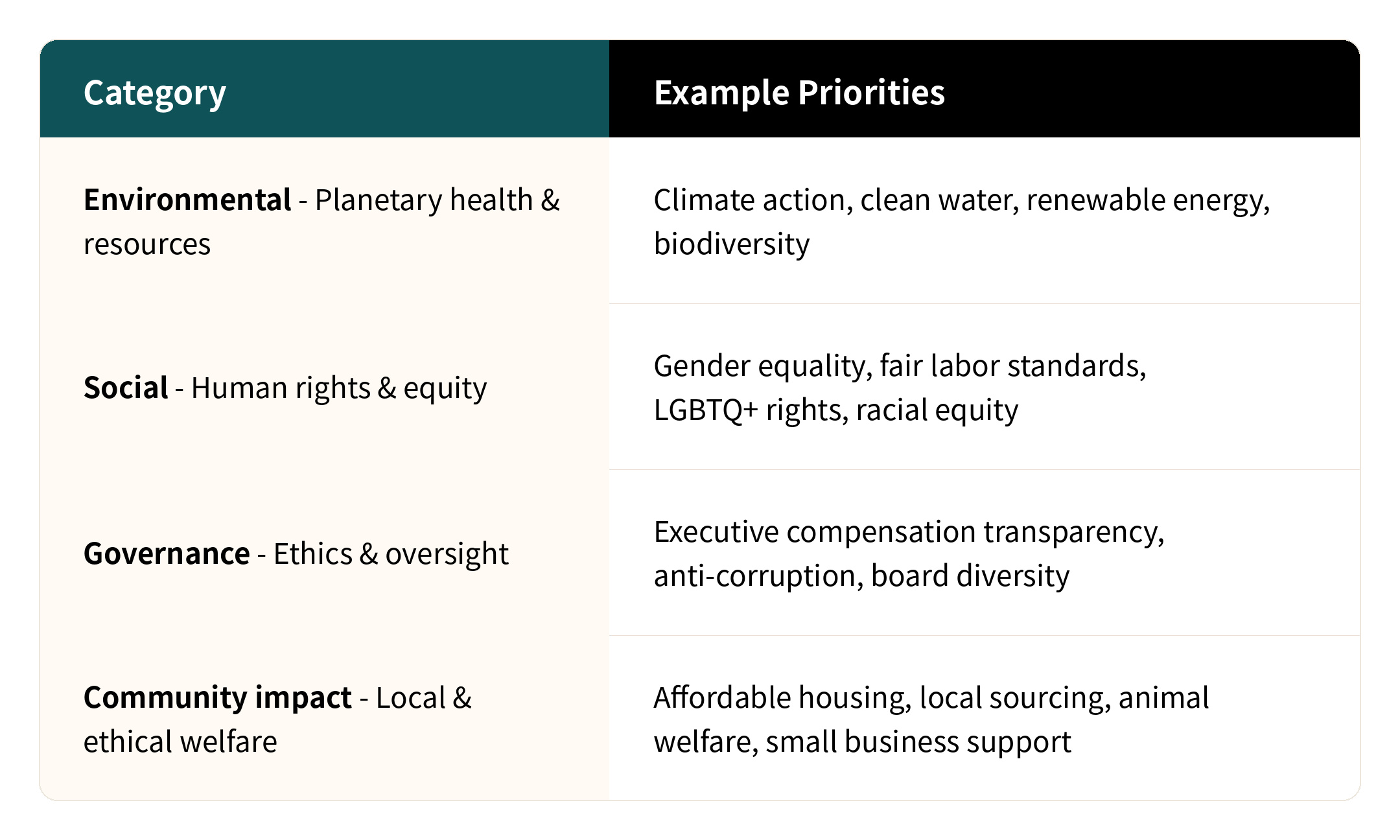
No public company is entirely perfect — an EV manufacturer might excel on emissions but draw scrutiny over supply chain labor. Aligning a portfolio with your values means deciding which metrics matter most, so you can prioritize consistently rather than case by case.
Step 2: Translate Values into Investment Criteria
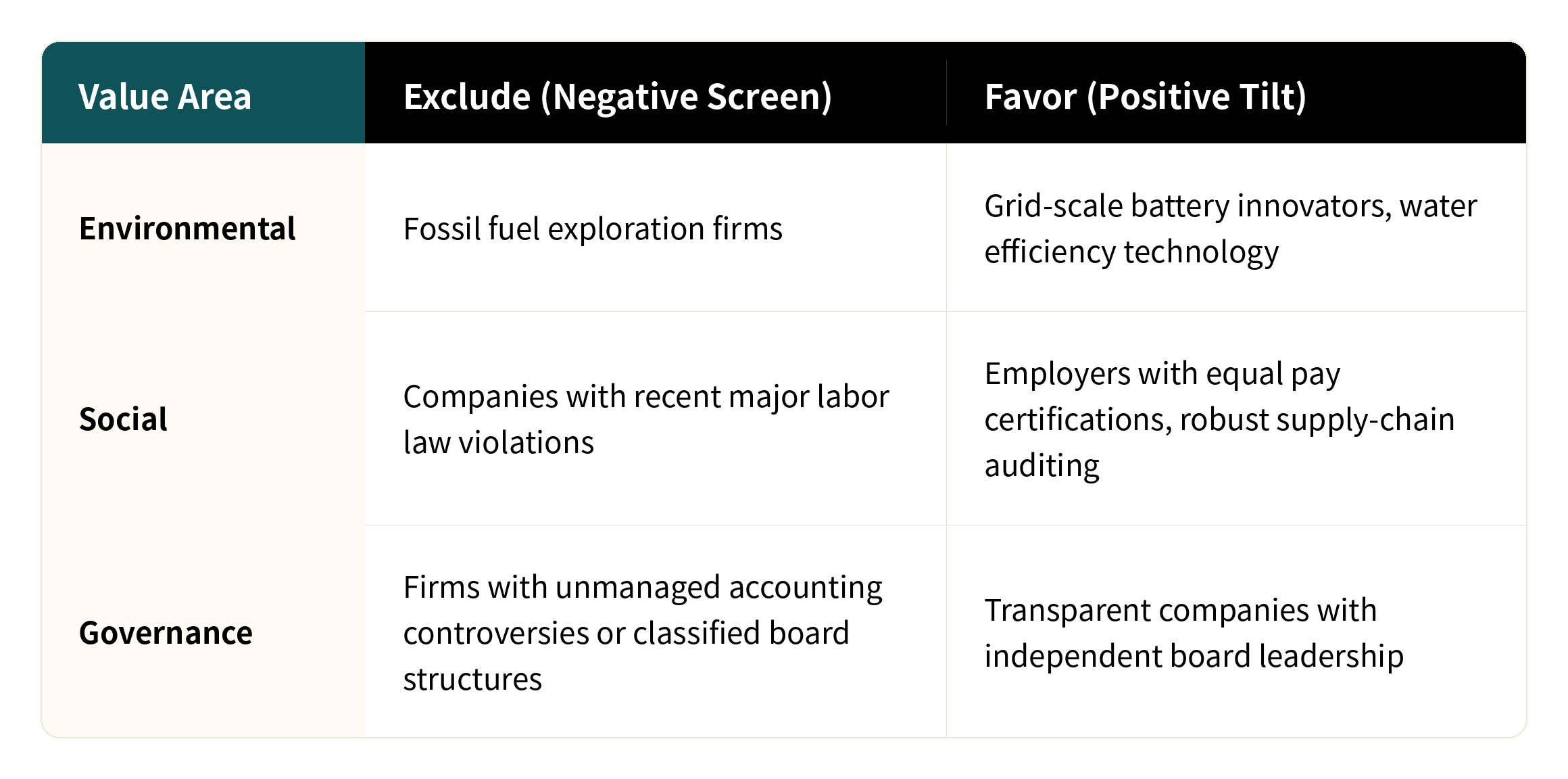
Once you’ve set your priorities, turn them into actionable, objective rules. For every core value on your list, define:
- Exclusions (negative screening): specific industries, products, or corporate behaviors you refuse to hold.
- Preferences (positive tilt): sector leaders, business models, or impact goals you want to actively favor.
- Measurable thresholds: quantifiable metrics, such as maximum revenue share from a specific sector, carbon intensity, or board diversity ratios.
Here’s what that looks like in practice:
Step 3: Screen & Select Companies
With criteria in place, start analyzing specific holdings — applying the negative and positive screens from Step 2, then layering on qualitative research. Third-party ESG ratings are a useful starting point, but treat them as one data input rather than a final verdict; they vary more between providers than most people expect. (For why fund-based ESG scores in particular tend to miss the mark, see Why Traditional Ethical Funds Fail Values-Aligned Investors.) Go beyond the score using this checklist:
- Sustainability reports: look for clear, audited baseline numbers rather than vague marketing language.
- Binding targets: verify whether the firm sets concrete, time-bound goals (e.g., net-zero operational emissions by 2030) with annual progress tracking.
- Regulatory record: check public databases for recent regulatory fines, environmental enforcement actions, or pending class-action lawsuits.
Step 4: Build Your Portfolio
Values alignment shouldn’t come at the cost of your core financial health. Keep a balanced mix of equities, fixed income, and cash based on your timeline and risk tolerance, avoid over-concentrating in a single niche industry — pure-play solar tech, for instance — and cap individual equity positions so a downturn in any one company can’t derail your broader trajectory.
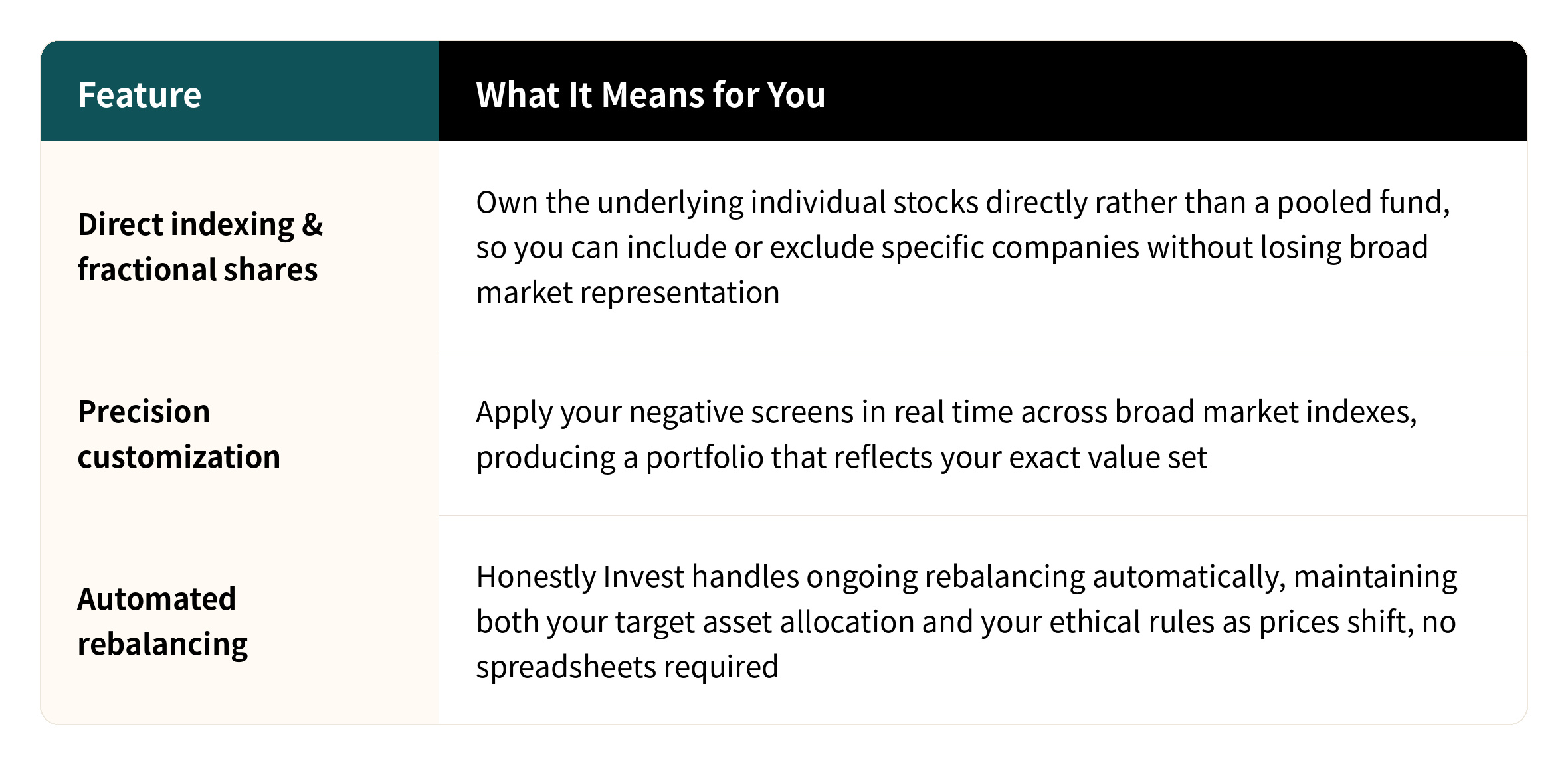
Traditional investing tends to force a choice between rigid, generic ESG funds and tedious manual stock picking. Honestly Invest is built to remove that trade-off:
Step 5: Monitor & Adjust
A values-aligned portfolio needs ongoing attention — companies change management, acquire subsidiaries, and shift strategy over time. Build in an annual review:
- Controversy audits: check whether current holdings face new regulatory actions or ethical controversies.
- Rating shifts: review any significant downgrades in third-party ESG metrics.
- Corporate M&A activity: verify that recent acquisitions haven’t introduced business units that violate your non-negotiable screens.
- Portfolio drift: rebalance asset weights that have drifted from your target allocation.
Documenting your screening rules up front creates a benchmark, which makes this review far faster than starting from scratch each year.
Take Control with Honestly Invest
Building a portfolio that reflects your personal values takes clarity, research, and the right execution tools — doing it manually is possible, but evaluating holdings and rebalancing periodically takes real time.
Honestly Invest simplifies that: full transparency and control over your portfolio, in place of generic ESG shortcuts.
Ready to build a portfolio as unique as your values? Get started free with Honestly Invest and invest with conviction.
Frequently Asked Questions
What happens if a company I’ve screened in starts violating my criteria?
This is exactly what the Step 5 annual review is for. If a holding drifts — a merger introduces a conflicting business line, a controversy surfaces, or a rating drops sharply — swap it for a comparable company that still meets your criteria rather than waiting for a full portfolio rebuild. Platforms like Honestly Invest can flag these shifts automatically as part of ongoing rebalancing.
How often should you rebalance a values-aligned portfolio?
Once or twice a year, or whenever market movements cause an asset class to drift significantly from your target allocation. Periodic rebalancing restores your intended risk profile and confirms that newly acquired holdings, or shifts inside existing ones, still comply with your original screening rules.
Do I need a large portfolio to use direct indexing and custom screens?
Not anymore. Direct indexing used to require enough capital to buy whole shares across hundreds of companies, which put it out of reach for most beginners. Fractional-share technology has changed that — platforms like Honestly Invest let you apply the same custom negative screens and diversification principles on a small account balance, not just a six-figure one.
Important Disclosure: Any information on this website or in this article is provided for informational and educational purposes only and is not intended as, and should not be construed as, investment, tax, accounting, or legal advice. Information provided should not be solely relied upon for decision-making. Please consult your financial adviser and/or your legal, tax, or accounting professional regarding your specific situation. Investments involve risk and have the potential for complete loss. It should not be assumed that any recommendations made will necessarily be profitable. The information on this website and in this article is provided “AS IS” and without warranties, either express or implied, and the information may not be free from error. Your use of any information on this website or in this article is at your sole risk.